
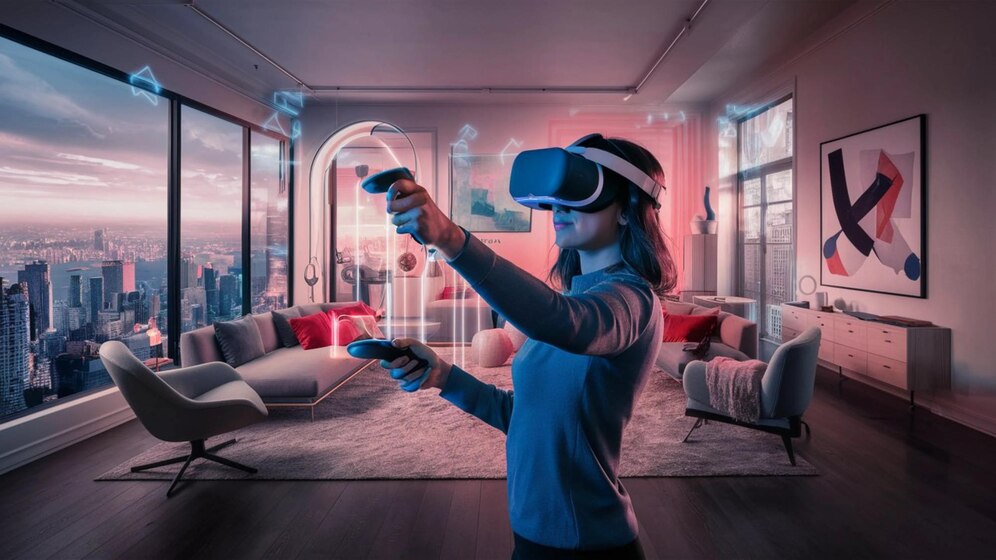
AR and VR Technologies: Transforming the Future
AR and VR technologies continue to advance rapidly, transforming business operations and customer interactions worldwide. By 2025, interactions between humans and digital or physical domains will change significantly due to technological developments. The following trends highlight what to expect in AR and VR for 2025.
Companies like AI application development and game development firms in Qatar lead the integration of AR and VR solutions into business operations and entertainment platforms.
1. Enhanced AR/VR in the Metaverse
The Metaverse depends heavily on AR and VR, forming its core conceptual elements. Major corporations like Meta, Microsoft, and Apple are investing heavily in virtual spaces where users can work, play, and socialize.
Furthermore, AR and VR headsets with enhanced haptic feedback allow users to experience realistic interactions. Artificial intelligence (AI) also increases responsiveness, which adds dynamic elements to virtual environments. Consequently, organizations working with AI application development in Qatar are creating immersive metaverse experiences for businesses and individuals.
Developers are also focusing on reducing technology interaction disruptions, improving human-machine relationships, and advancing daily operations.
2. AR/VR in Healthcare
AR and VR are revolutionizing healthcare applications in 2025. These technologies improve both training and patient care.
Surgeons can rehearse complex procedures in risk-free conditions using AR overlays, which enhances accuracy and reduces procedural risks. Moreover, VR treatments offer patients pain relief, mental wellness support, and physical rehabilitation.
The healthcare industry is expected to adopt AR and VR solutions rapidly. In addition, companies and game development companies in Qatar are helping healthcare providers create simulations and interactive tools that enhance training and patient care outcomes.
3. 5G-Enabled AR/VR Experiences
The rollout of 5G networks makes AR and VR experiences faster and more accessible. Low-latency, which means minimal delay, and high-speed connections allow real-time interactions, improving virtual work, gaming, and tourism experiences.
Additionally, 5G enables cloud-based AR/VR applications, reducing hardware requirements. Users can now access uninterrupted, high-quality content on smartphones, AR glasses, and standalone headsets.
As telecom companies expand 5G infrastructure, adoption rates of AR and VR solutions will rise across sectors such as education, retail, and corporate operations. Organizations leveraging AI application development in Qatar are already optimizing 5G-enabled AR/VR solutions.
4. AI-Powered AR/VR
Artificial intelligence plays a key role in AR and VR development. AI algorithms enable virtual environments to adapt to user behavior, creating personalized and interactive experiences.
For example, AI enhances non-playable characters in games, making them appear more realistic. In retail, AI-driven AR allows virtual dressing, product customization, and recommendations. AI virtual assistants also deliver relevant information to employees, boosting productivity.
Consequently, game development companies in Qatar and AI specialists are using these technologies to build interactive applications that meet users’ needs effectively.
Frequently Asked Questions
1. How will AR and VR technologies impact daily life in 2025?
AR and VR will enhance communication, entertainment, and work activities. Users can attend virtual meetings, enjoy immersive gaming, and engage in social activities, improving both efficiency and engagement.
2. Which industries will benefit most from AR and VR in 2025?
Healthcare, education, gaming, retail, and real estate will see the largest gains. Surgeons, students, and retailers will adopt AR/VR for training, virtual shopping, and property viewing, respectively. Companies like the game development company in Qatar are creating these solutions.
3. How does AI improve AR and VR experiences?
AI enables adaptive, personalized virtual environments. It enhances interactions with game characters, automates content creation, and provides instant recommendations, resulting in more realistic simulations. Organizations utilizing AI application development in Qatar are driving these innovations.
4. What role does 5G play in AR and VR?
5G ensures rapid, low-latency connections, enabling real-time interactions. It supports cloud gaming, virtual tourism, and remote collaboration while improving access to high-quality AR and VR content.
5. Are AR and VR headsets becoming more affordable?
Yes. Increased competition and declining production costs have made headsets lighter and cheaper, expanding access to a wider consumer base.
Conclusion
The development of AR and VR technologies will transform multiple sectors, from business to personal interactions. Companies and individuals who adopt these trends can strengthen their position in the digital market. Furthermore, AI and 5G integration will enhance user experiences, making AR and VR essential tools for the future.
AI application development in Qatar is leading this digital transformation, helping businesses and developers implement immersive AR and VR applications that increase engagement, efficiency, and satisfaction.